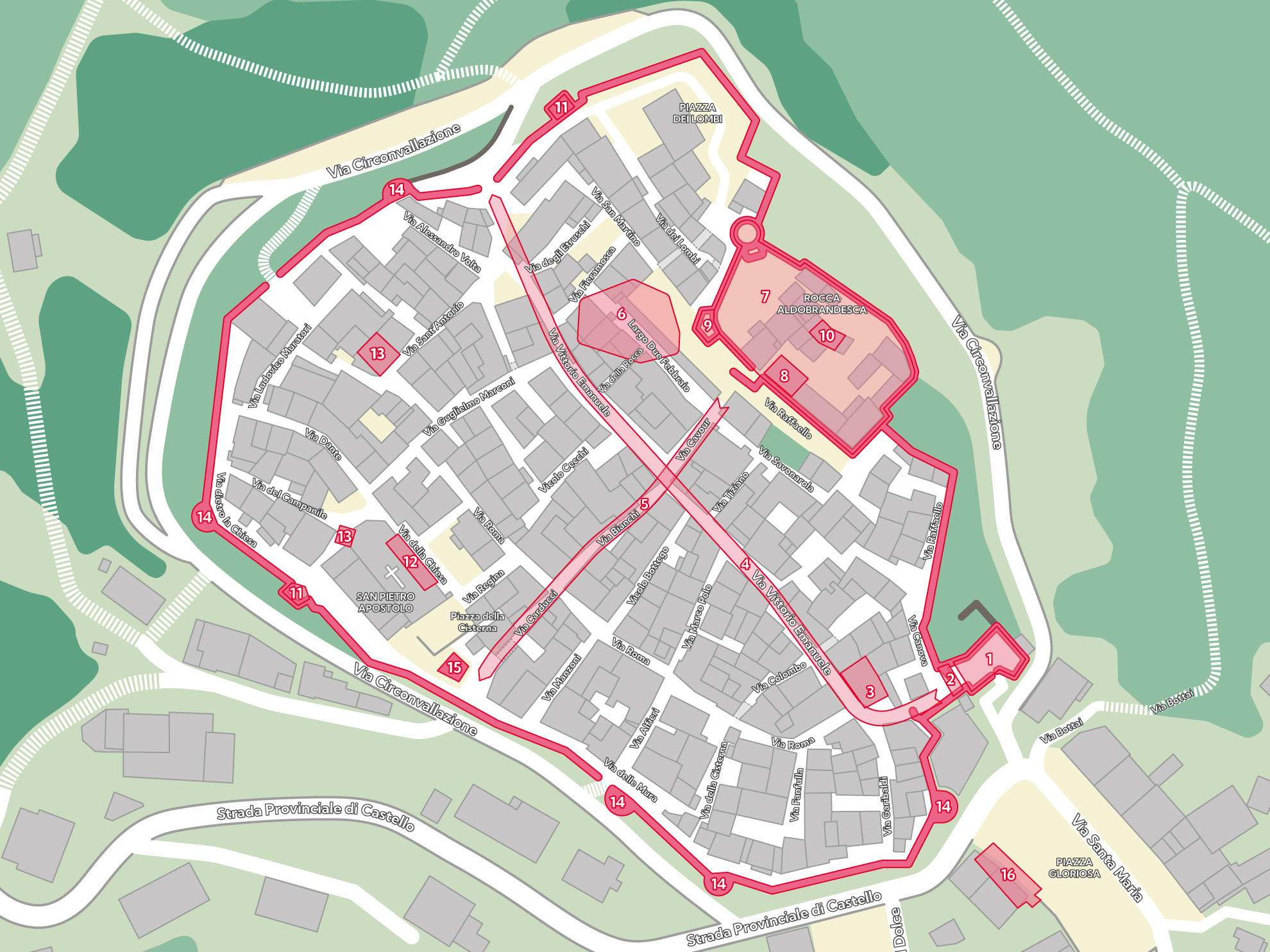
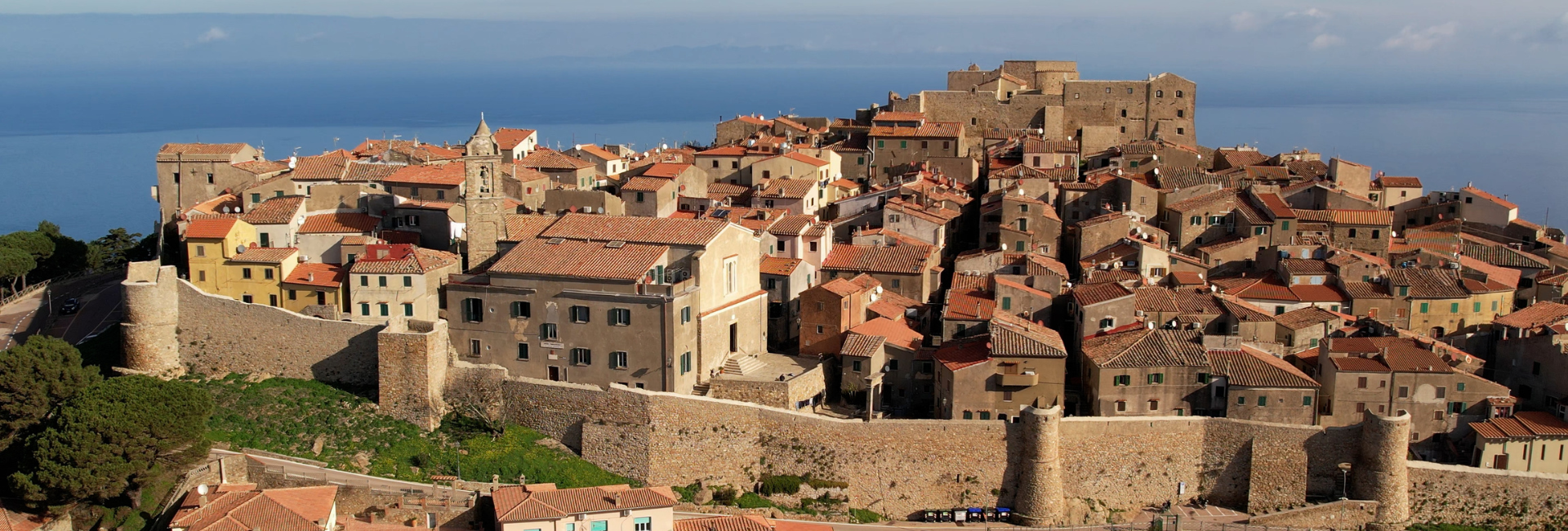
The structure of the castle wall circuit
The Castle Wall
Home " Places of interest " 14 The city walls
🎧 Listen to the guide (Italian)
🎧 Listen to the guide (English)
🎧 Écoutez la guide (Français)
🎧 Escucha la guía (Español)
🎧 Hör dir die Führung an (Deutsch)
Whatever the structure of the castle wall circuit was in the late medieval phase, the result of at least two major construction phases that are not well documented at the moment, significant work must have been done during the early modern age because they were restored or rebuilt beginning in 1595. However, it does not appear that the reconstruction changed the earlier form. Rather, it seems to have been an adaptation to the new requirements of cannon use, which to a large extent incorporates material from the older walls.
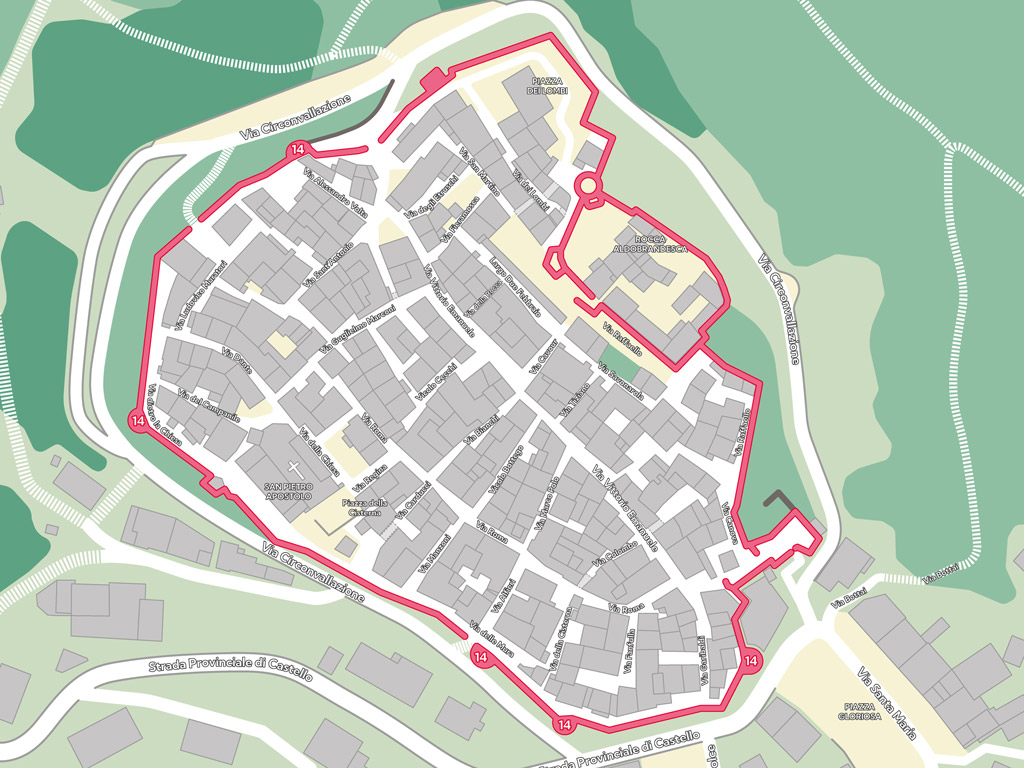
Thus we could hardly assume a very radical intervention as for Grosseto, where the medieval walls were almost entirely demolished and rebuilt in new forms.
Since the most reconstructed part in the Medici intervention corresponds to the southern portion, it is currently not possible to know whether it is only the result of the war events of the mid-16th century or whether it is also partly natural degradation due to lack of maintenance.
The curtain walls and towers currently visible, with the exceptions we have reported, all appear to be attributable to a single intervention even though they incorporate structures and reuse materials from earlier buildings.
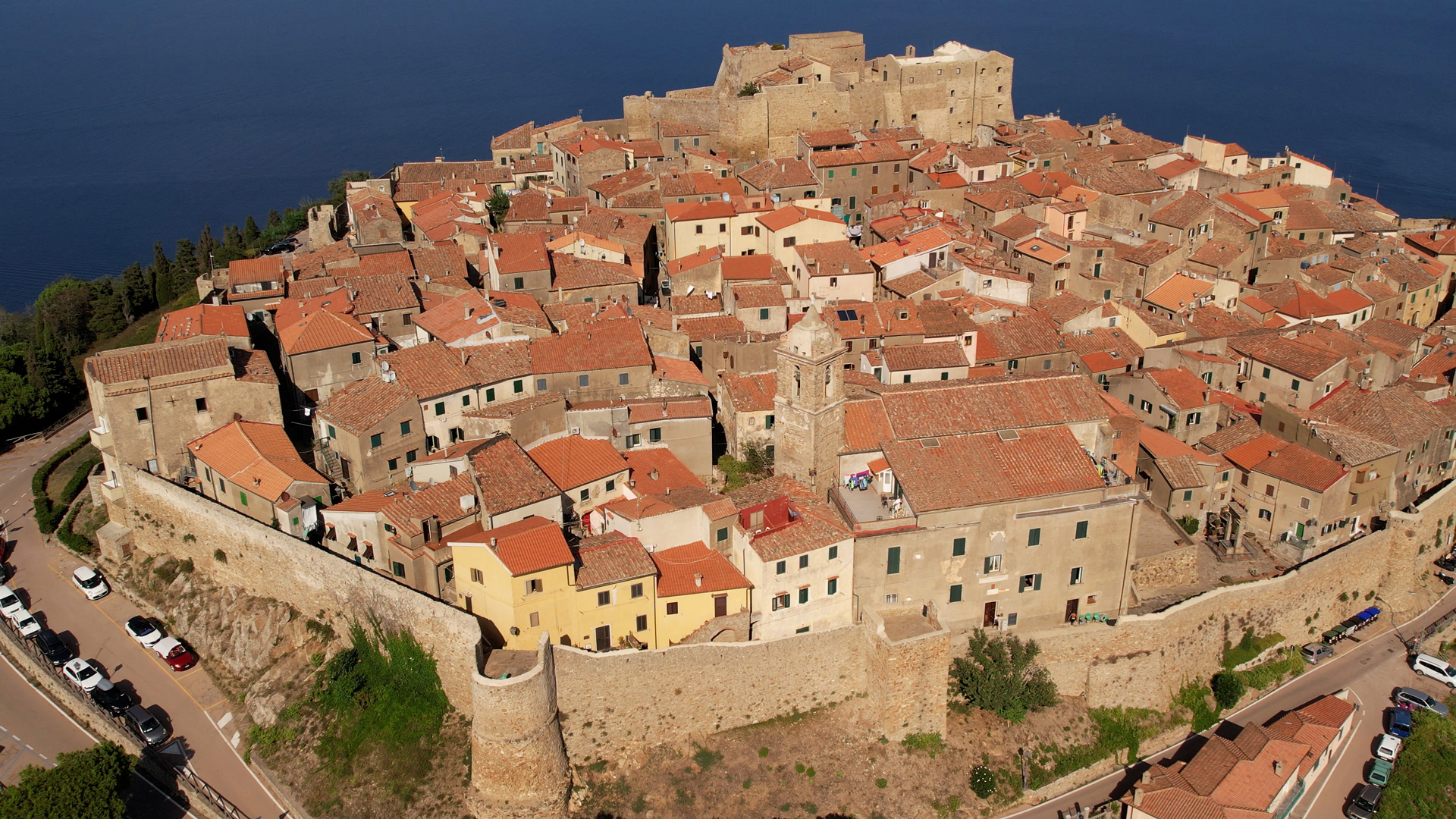
Circular towers were not unknown in the Italian context, especially in southern regions.
Here they are found from the middle of the 13th century in a great many castles, but their development in the central and northern regions occurs with the systematic introduction of new siege techniques and the use of gunpowder. The concern that a musket could be fired from the hill above the castle inside the fortress was a novelty that had not occurred in the mid-medieval period.
The walls are mentioned in several places in the 1558 statutes, but always as a legal space for guard duties or other functions.
We do not have descriptions of their state of preservation, but these are gleaned from other sources such as the Magi report of 1671 (Roani Villani 1993, pp. 101-107) or the Warren report of 1749 (ibid., pp. 112-114).
The latter in particular provides us with some interesting insights.
The castle is surrounded by walls with circular towers and narrow loopholes, and the fortress is further fortified and is home to the administration and the few soldiers stationed on the island.
We recall among other things Cosimo I dei Medici 's concern about the need for a fortification on the island that would serve the real needs of defense.
Within this framework we might grasp a strategy that together with Grosseto aimed at strengthening the southern frontier vis-à-vis Spain and the Pope.
The cited Magi and Warren reports do not seem to refer to a system in ruins, although clearly in need of continuous restoration. An initial cursory analysis of the wall faces shows that the outer circuit may already be the result of a late medieval reconstruction or extension operation on which, however, we can record numerous interventions.
A few circular towers show conspicuously that they were added on top of a landslide or destroyed face, while in the upper part of the masonry of part of the circuit of both the fortress and the outer walls with smaller stones arranged chaotically.
Finally, we point out a plan preserved in the Florence State Archives from the second half of the 16th century that shows both the area of the fortress and the city walls following renovations.