
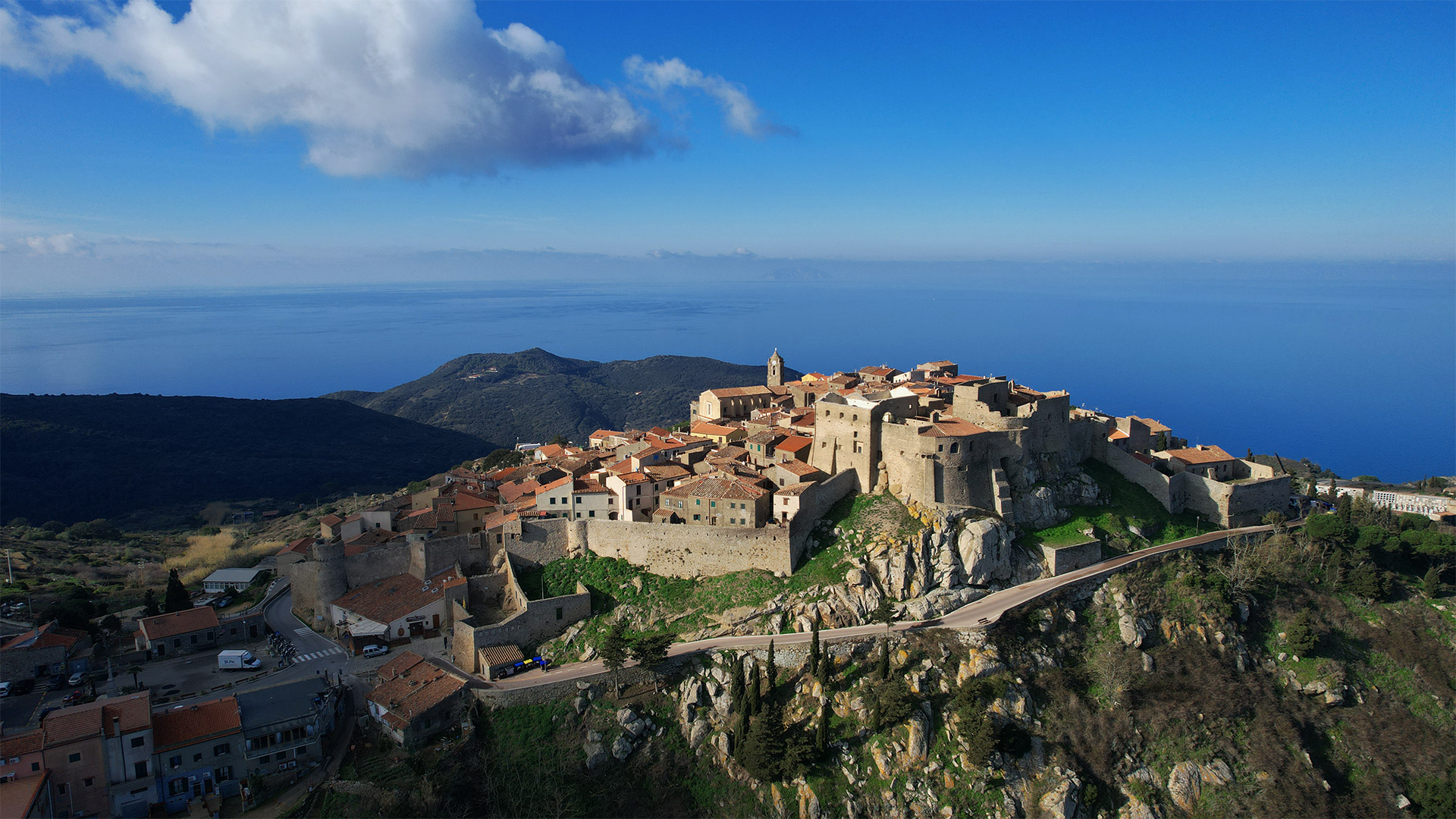
The island of Giglio
Etruscan and Roman Age
Home " The island of Giglio " Etruscan and Roman Age
The harbour function remains in the Etruscan period although there are few surface records prior to the Hellenistic period at Secca dei Pignocchi, Secche del Campese, Punta della Calbugina (Corsi 1990, p 127).
More substantial, however, seems at the moment to be the human presence between the fourth and third centuries B.C. thus at a time when Rome was pressing in from the south (recall that the conquest of Vulci was in 280 while Roselle had already fallen in 294).
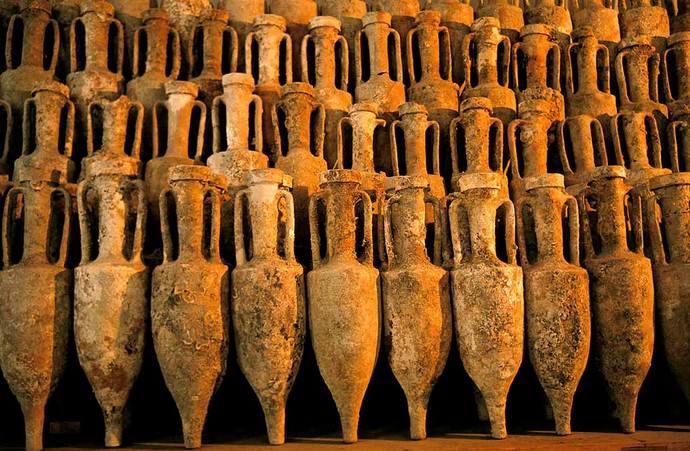
For this reason, the findings of archaeological material from the 3rd century B.C. could be placed in a phase of Rome's redefinition and acquisition of control of the Tyrrhenian route.
Sites at Castellare, Faraglione and Torre del Campese, punta del Fenaio, Fontuccia, Sella di Scopeto, Pitocci, La Vena and Valle di Vantini seem to fall within this context (Corsi 1990, p. 126).
The finding is confirmed by the Montecristo wreck, which carries many ceramics of a type associated precisely with Rome 's economic and political penetration routes into the Tyrrhenian Sea (Celuzza, Rendini ed. 1991, p. 53).
However, the Campese wreck is dated between the seventh and sixth centuries B.C. and shows the importance of the island in Greek and Etruscan routes along the Tyrrhenian Sea (Corsi 1990, p. 127). Importance also confirmed by the Archaic Etruscan settlement of Campese (Rendini in Aranguren et alii 2004).
Harbour functions seem to become preponderant during the Roman period until very late (Celuzza, Rendini eds. 1991).
Information from both wrecks and excavations undoubtedly show prolonged and intense activity at the Port until the entire 7th century CE in a framework of control of the Tyrrhenian route by theempire, while the Campese area seems to have been abandoned earlier.
In both cases all or significant parts of the island had flowed from the Domitii Ahenobarbi family to the imperial res privata, that is, to those properties that the emperor managed through a separate administration for court functions (Chirico, Citter 2018).
Altogether in the fourth century these came to cover one-seventh of all the land in the western part of the empire, thus a heritage unimaginable today.
It is in this context that we must place the subsequent historical developments on the island.
On the other hand, the quote from Claudius Rutilius Namatianus writing for a small audience of non-Christians at a very sensitive time for them (Rutilius Namatianus) should not be misunderstood.
We must remember that he was forced to return to his homeland because the situation in Rome was no longer favorable to the non-Christian faction headed until a few years earlier by the likes of Symmachus.
While his bleak view of the cities and countryside certainly has a basis in the gradual fraying of the typically Roman connective tissue, it is nevertheless emphasized in a negative sense.
We can certainly accept that there were hermits at Giglio, as throughout the archipelago (Belcari 2009), but the archaeological record shows a great vitality of the harbour for at least another 200 years.