
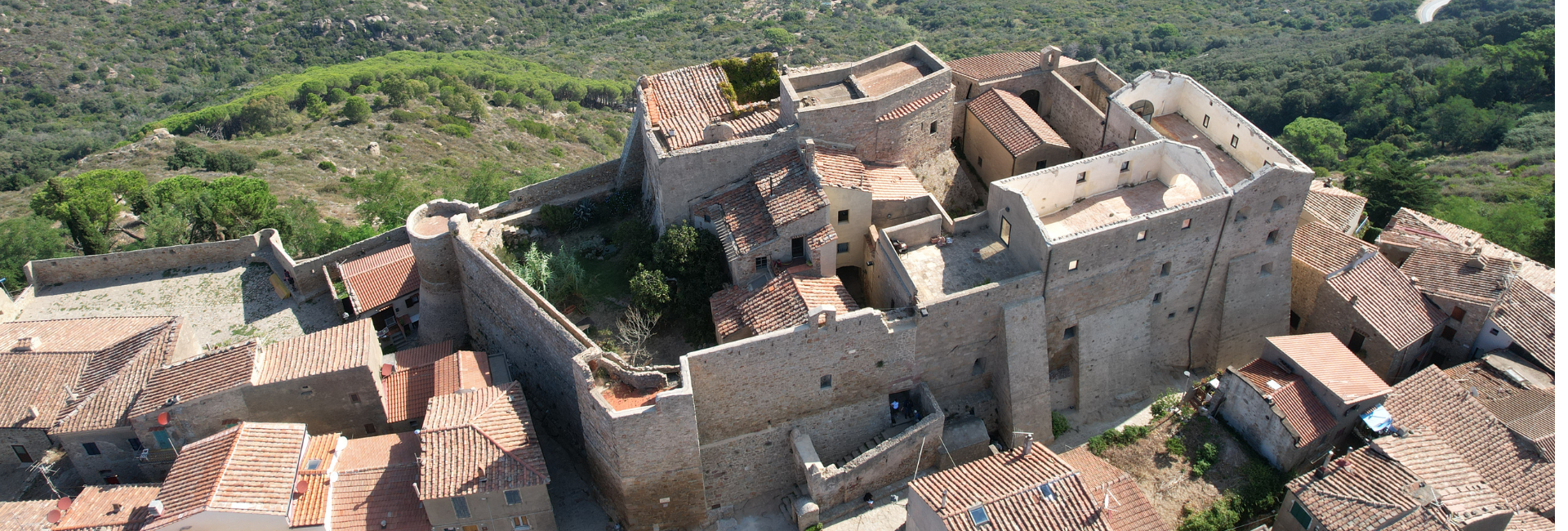
The Castle
The Middle Ages
Home " The island of Giglio " Middle Ages
During the Byzantine period, Rome 's defense was ensured by sea from the ports of Civitavecchia, Luni, Elba Island and possibly Populonia, as attested by George Cyprius' list between the late 6th and early 7th centuries CE (Cantini, Citter 2022).
In this framework therefore the attestations at Giglio porto could be framed as a secondary landing place in the military system of maritime defense guaranteed, however, in a very modest way (if we assume a garrison corresponding to a regiment also called numerus of about 300 men in each of the mentioned localities we arrive at 1,200 for a stretch of more than 300 km).
By the8th century, however, the island no longer seems to be in full and exclusive public control. This is where Charlemagne's famous and disputed diploma to theabbey of St. Anastasius ad Aquas Salvias better known as the Three Fountains (MGH, Diplomata doc. 274 a.a. 805) comes into play.
In tradition this monastery is founded by Narses although it is actually a century later and had in the early Middle Ages a strong Greek imprint. Thus the donation by public authority to the monastery is not surprising in the period when the empire still controlled Rome, i.e., the seventh century (the island must have been part of that jurisdiction that the Anonymous of Ravenna calls Maritima Italorum - cf. Citter 2007, p. 454).
It might cause some puzzlement when the donation is made, or perhaps only confirmed, by the new ruler of the western part, precisely Charlemagne.
The document itself is a forgery in the sense that it was produced no earlier than the late11th century, but the copies that have come down to us are later.
However, its essence seems authentic (Farinelli 2007, fiche 20.1 but see the objections of Collavini 1998, pp. 264ff.) for one simple reason, as already pointed out (Citter in Citter, Valdambrini 2015, p. 393): the document concerns a territory whose boundaries perfectly trace those of the Roman municipium of Cosa.
This datum could not have been known in any way to the forgers, who also ignored this which was the Latin name for Ansedonia (on the origin of the name, it is believed that the solution proposed by Patitucci, Uggeri 2012 that makes it derive from ad sitonia, that is, imperial granaries, is the most correct).
So there must really have been a document, and we can assume that it was an original intended specifically for the Roman monastery of the Greek rite. In this context perhaps the controversial Byzantine inscription from Orbetello (Citter 1993 and later for a correct dating von Valkenhausen 2003) dated to the 8th century referable to persons of rank in the imperial administration of Rome could be the only evidence, together with the altar frontal from Orbetello (Ciampoltrini 1991) of a strong link with Rome of the whole coastal belt and thus also of the archipelago.
Recall that at Ansedonia is one of the most important finds of heavy glazed pottery datable to the 9th and 10th centuries of Roman production (Briano 2020, p. 46). However, the cited literature also does not rule out a connection with the Lombard king Liutprand in a brief period of good relations with the papacy.
Moreover, we note in the margin that the relationship between the island of Giglio and the Roman abbey was so strong that even in 1772 Cardinal Pietro Colonna Panfili, perpetual commendatory of the abbey, visited the island (Begnotti 1999, p. 105).
So it is not surprising that in a period of transition large areas once in public ownership were given over to monasteries.
The same thing happened in the Lombard kingdom beginning with Liutprand himself and then in a far more systematic form under the Carolingians throughout Europe.
We can also make the hypothesis, but there is no archaeological or documentary confirmation, that the mention in the same document of 805 of a siege of Ansedonia proper does not refer to actions taken by Charles but an echo of the conflict between the Empire and the Lombards for control of the Tuscan coast.
However, the political situation in which the forgery was drafted is very clear and explains its origin. From the end of the 11th century, the Aldobrandeschi began a very aggressive policy of territorial conquests aimed at creating their own state between southern Tuscany and upper Latium over which to exercise seigniorial rights (which is different from wanting to acquire land as mere owners). We know from a late document of 1269 (Collavini 1998, pp 264ff. with bibliography and earlier sources) that the family had in emphyteusis (i.e., the property remained with the abbey but the Aldobrandeschi enjoyed the profits as long as they improved its conditions) from the abbey of the three fountains a large territory, corresponding to that of Charlemagne's forgeries with islands including Giglio.
This situation was not new and can be dated from at least the mid-12th century although it is not possible to determine what was actually given from time to time. Certainly the Aldobrandeschi entered a phase of crisis in the monastery between the 10th and 11th centuries and took advantage of it.
The gradual replacement of monastic control by lay control was not painless, nor was it immediate and complete.
Indeed, we know that the Pisans had raided near the island as early as 1063 (MGH, Chronica monasteri casinensis III, 20, 21, p. 387, a.y. 1063).
That the Pisans had no intention of relinquishing control to the Aldobrandeschi or to Siena is also evident from a privilege of Ludovico IV of 1328 (MGH, Leges, VI, 530) that is offered as confirmation, although there is no sure antecedent because the other great privilege, that of Frederick Barbarossa of 1162 (MGH, Leges, I, 205) does not mention the island but seems to stop at the coast from Scarlino to Porto Ercole. Several military operations affected the island, at least two of which have left evidence in the documentation: the 1241 battle involving the Pisans and Genoese between Montecristo and Giglio (MGH Scriptores, V, 2: Dietrich von Nieheim, p. 100) and Frederick III of Aragon 's 1328 expedition (MGH, Leges, VI, 486).
So, in a nutshell, we have to imagine that between the11th and 14th centuries the island was contested between different actors, precisely because it never ceased to exercise a central role in the Tyrrhenian route.