Exploring the landscape: new perspectives in geographic study
Today we can also study a geographic area from other perspectives. Understanding what a landscape looks like, what its characteristics are, what possibilities it offers forhuman settlement and mobility are essential elements in the overall assessment of the potential even in economic terms for ancient societies.
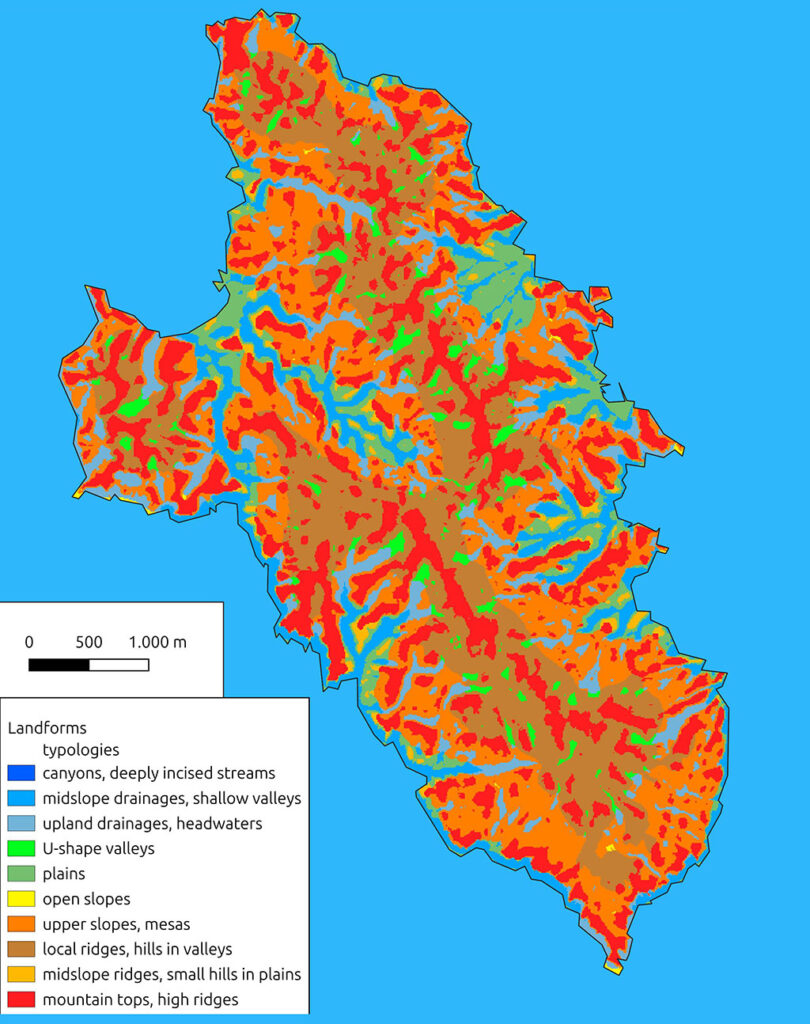
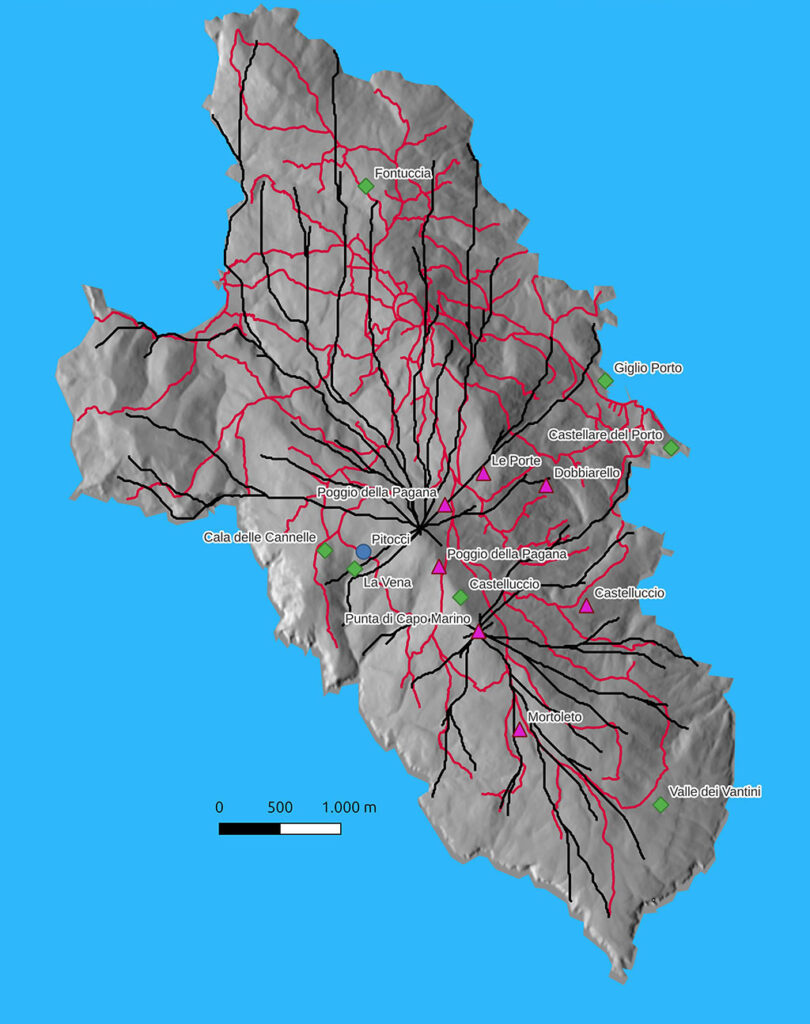
Morphometric analysis returns a fairly clear picture (fig. 2). Theisland is characterized by a main cordon that at Poggio della Pagana divides into two branches: one continues to the Giglio Castello the other toward Campese.
Even this first observation alone shows the centrality of the protohistoric site of Poggio della Pagana in a context of strategic control of the island.
The rest is made up of recessed canyons and a series of reliefs that leave very little room for cultivable areas partly because the rocky paleosol, consisting almost exclusively of granite, if it has favored mining (Matthias 1998) has certainly negatively affected the possibility of cultivation.
We also report the presence of surface iron mineralization (pyrite - Aranguren et alii 2004) also cultivated during the Medici period (Begnotti 1999, ch. XIV) and we can imagine in earlier centuries as well.
Good wine production has been attested in recent centuries, but this does not mean that even in ancient times this resource was exploited, since until the mid-19th century people preferred to plant vineyards on the plains.
Figure 2
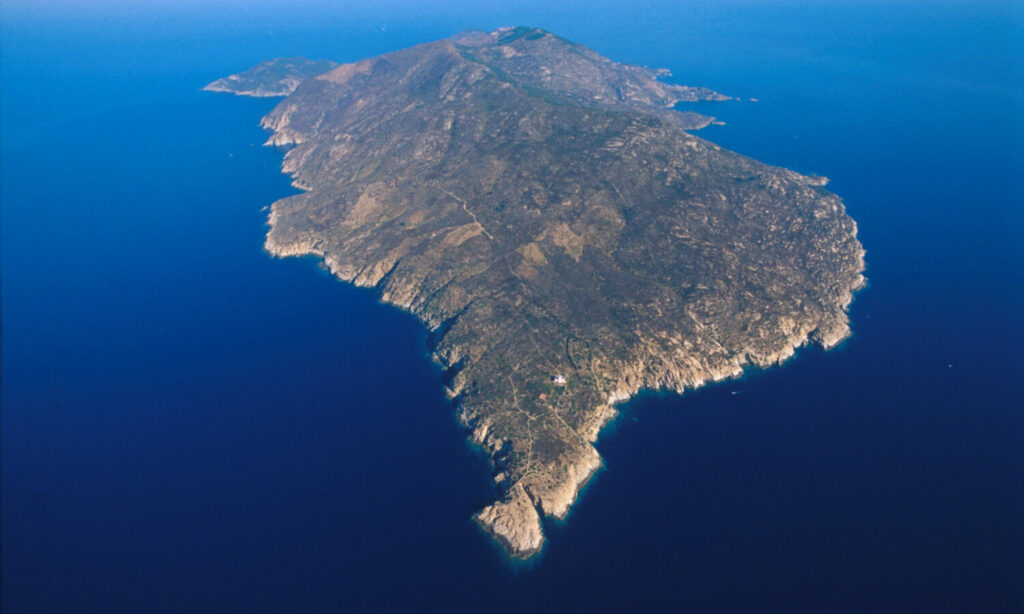
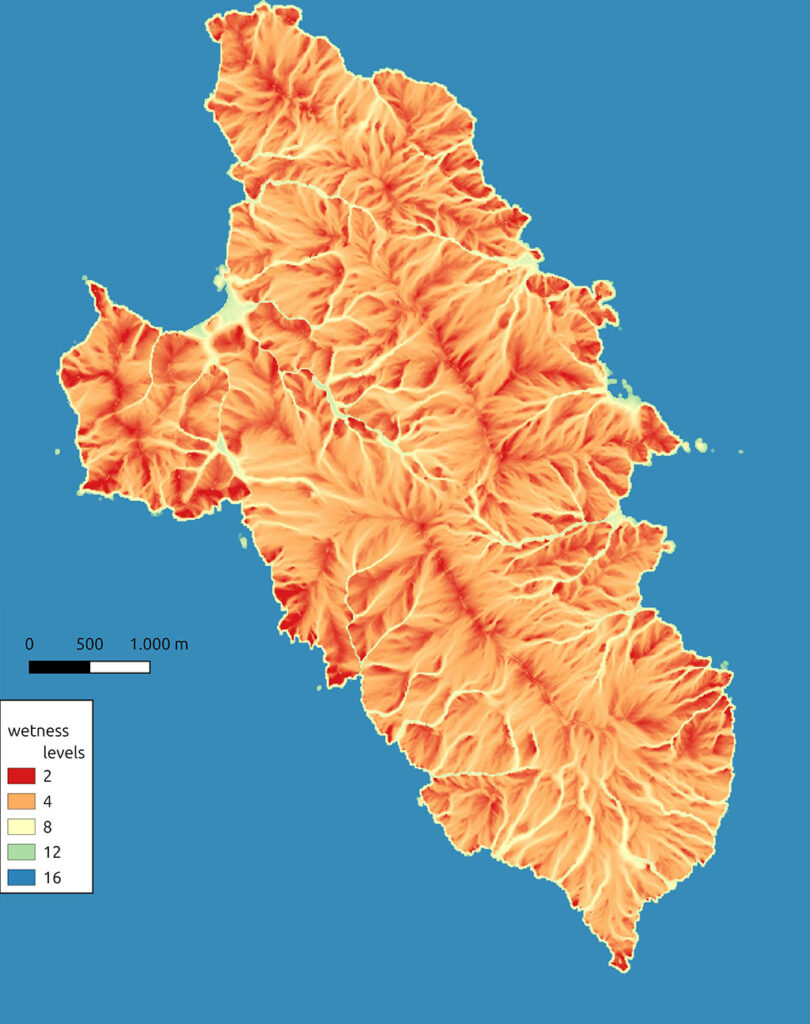
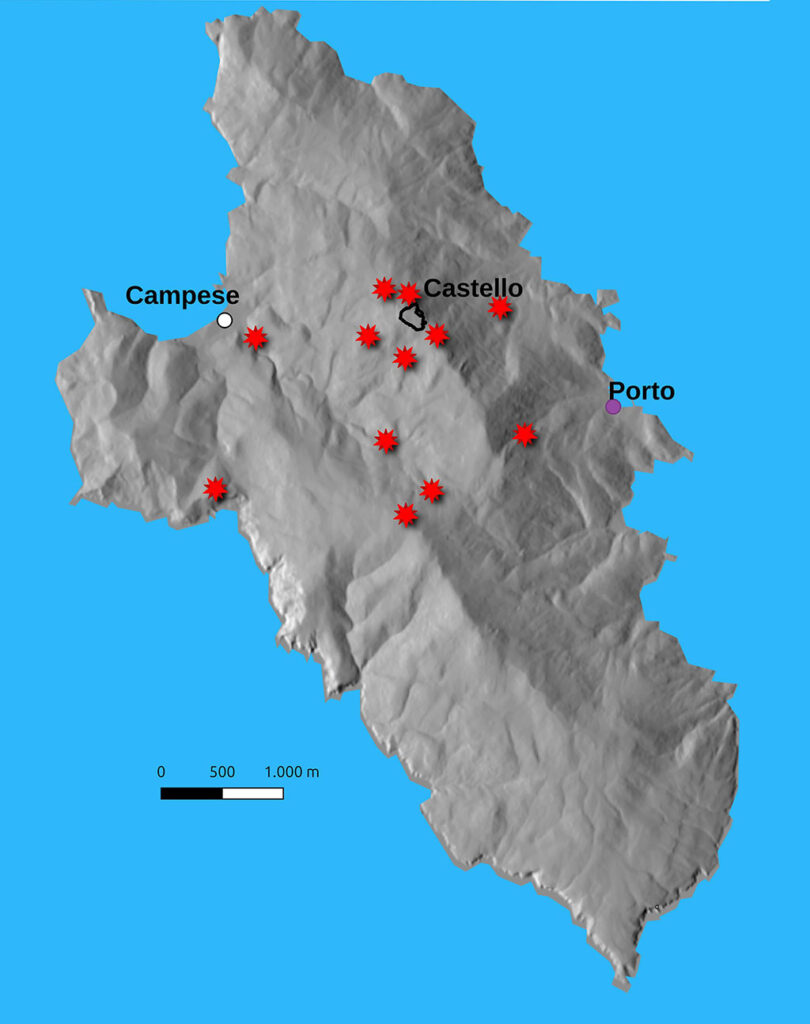
Moisture analysis also shows that the only two areas of potential stagnation are at the two harbors (areas in green/blue - Fig. 3), so the possibility of cultivation for the subsistence of the population is reduced to modest terraced plots, some of which can be seen from the aerial photo albeit in a state of disrepair.
This morphology has heavily affected connectivity.
Figure 3
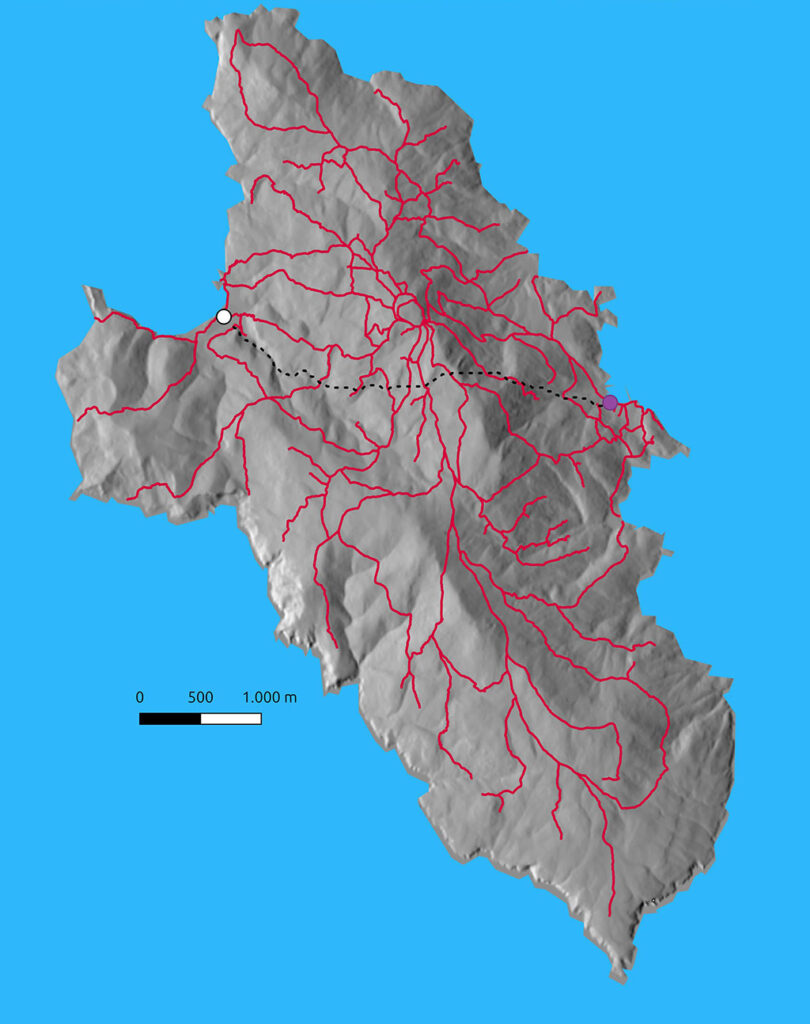
A 360-degreemobility simulation from the two main protohistoric sites showed that they were in a position from which one could easily connect with both landings (fig. 4). But there is no relation to the network of roads and paths recorded in the Lorraine cadastre compiled in the first half of the 19th century. The latter is in fact centripetal from the Castle.
Thus we can infer that the road system that is still largely visible on the island today is only formed from a time when the castle becomes the central place on the island.
And this could not have happened before the 12th century when between the Aldobrandeschi and Pisa the island returned to play a role in the new Mediterranean trades.
Figure 4
But if we try to simulate the best connection between the two ports, the situation does not change. Overlapping with the road system in the Lorraine cadastre provides no overlap (fig. 5).
This means that once again the entire road system first photographed in the early 19th century must have originated in the middle of the Middle Ages with subsequent additions and adjustments, moreover still in progress.
The presence of several springs and mills (Hall 1953) suggests thatwater has never been as dramatic a problem as it has been for other islands that are entirely without springs.
These always form at the point of contact between a permeable and an impermeable layer. In the case of Giglio, the permeable part is the surface disintegration of the granite. The main springs are all in the central part of the island, and there are significantly some concentrated around the castle (Roani Villani 1993, p. 39). Minor springs are also at the ports, although at least for the Roman age we have to imagine storage systems with cisterns for the needs of maritime traffic.
Figure 5
The amount of springs around the castle must be the main reason why at some point thiselevation was chosen over others of earlier ages.
With equal or near equal visibility, a significant advantage could have been achieved for a larger population.
However, several times over the past few centuries the need to provide a constant supply easier for the villagers within the castle has been reported.